
Cheatsheet Summary
HTTP Request Smuggling is an interference vulnerability that occurs when a front-end server and a back-end server disagree on the boundaries of HTTP requests. By manipulating the Content-Length (CL) and Transfer-Encoding (TE) headers, or exploiting HTTP/2 downgrades, an attacker can smuggle hidden requests.
To identify Request Smuggling, we must observe how the front-end and back-end handle ambiguous requests using either the Content-Length (CL) or Transfer-Encoding (TE) headers.
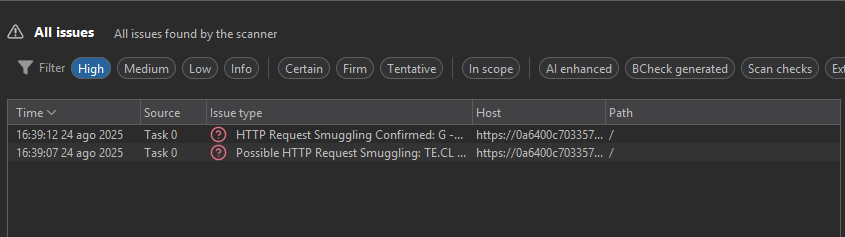
💡 Tip: Always use tools like Burp Suite's "HTTP Request Smuggler" extension to automate discovery. Check for CL.TE first to avoid poisoning the socket for other users.
No comments yet.
Be the first to share your thoughts
Log in to join the discussion.
Sign In